
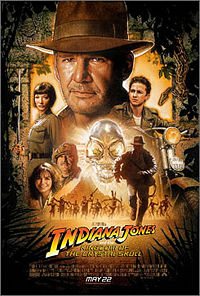
 Meditations before May 22nd: Indiana Jones and the Kingdom of the Crystal Skull
My wife recently picked up the first three Indiana Jones movies at a garage sale, and my boys have loved watching them, discovering the movies that I remember fondly from my years growing up. Of late, anything—a piece of rope, a broken bead necklace—has become an instant stand-in for Jones’ whip in our house.
In the first movie, I recall so well how Indy fought all the Arabs, punching and whipping his way free as he searched for the kidnapped Marion. Then that deadly swordsman appeared, twirling his blades madly. Oh, the humor and perfection in that moment when Indy pulled out his gun and shot the bad guy. Harrison Ford actually came up with the idea when, bored after too many takes, he did just that. One of those cherished moments from my childhood movie memories.
As a recent NPR piece on Indiana Jones and archaeology put it, Dr. Jones is “handsome, and he can beat up most anybody. He’s definitely a stud — with tenure.” But is he saving history or stealing it?
The Story on Archaeology
Archaeologist Winifred Creamer makes no bones about it: “You could say Indiana Jones is the worst thing to happen to archaeology, because Indiana Jones has no respect for anybody and anything. Indiana Jones walks a fine line between what’s an archaeologist and what’s a professional looter.”
But Creamer also confesses that students love Indiana Jones. As one student puts it, “I thought it was damn cool. I wanted to do that… (Indy) does everything that all archaeologists would like to do. Go on crazy adventures, fight bad people, not steal stuff but save it from being destroyed by the bad guys.”
That becomes a hook for Creamer: “They come in thinking that they are going to talk about pyramids and gold and serious cool stuff. Instead, people want to talk about tree-ring dating and radiocarbon dating and the atmosphere, so some are really turned off by it. Others are intrigued by puzzling out an answer and the problem-solving aspect of it, and some of them stick around.”
Creamer notes that a “true archaeologist is more interested in the context” of the whole tomb, rather than destroying it to get one artifact. The tomb can tell us about life in a past culture—that is our true treasure. And that treasure comes through the gathering of data, not pieces to show off. Rather than tomb raiding, it’s painstaking excavations. This type of good science, coupled with modern-day anthropological comparisons, tells us a lot more than solving the mystery of one covenant on film.
Indy and Science
Love vs. the worst thing, destruction vs. truth—obviously anthropologists are ambivalent about Indiana Jones. The archaeologist Cornelius Holtorf writes in The New Scientist that “Indiana Jones Is No Bad Thing For Science.” This charismatic hero gives the field popularity. What other fields have such a great figure to attract interest? And, besides, just as with sci-fi movies and real space travel, audiences can distinguish between fact and fiction.
But as Holtorf also notes:
What weighs far more seriously is the criticism that elements of the film scripts communicate highly objectionable values. The adventures of Indiana Jones are premised on an imperial world in which western archaeologists routinely travel to the far corners of the globe in order to retrieve precious artefacts and save the world from Evil, giving the impression that the world is dependent on intervention from the west. Moreover, the films draw on a long cinematic tradition of portraying archaeology as the domain of white, heterosexual, able-bodied and comprehensively talented men who live though action-packed adventures in foreign countries.
Continue reading “The Kingdom of Indy, Skullduggery and All”




 Neuroanthropology