The Battle between the Sciences and the Humanities

Natalie Angier writes today on a “Curriculum Designed to Unite Art and Science.” She starts where most people in this area start, with CP Snow’s famous lecture The Two Cultures and the “mutual dislike” between “natural scientists” and “literary intellectuals.” Snow’s gap has widened in recent decades, Angier implies, through the increased Balkanization of knowledge and vicious academic turf wars.

Today, however, Angier declares, “a few scholars of thick dermis and pep-rally vigor believe that the cultural chasm can be bridged and the sciences and the humanities united into a powerful new discipline that would apply the strengths of both mindsets, the quantitative and qualitative, to a wide array of problems.”

One new proponent of this synthesis is the evolutionary biologist David Sloan Wilson, author of the recent Evolution for Everyone. As Angier relates, “In Dr. Wilson’s view, evolutionary biology is a discipline that, to be done right, demands a crossover approach, the capacity to think in narrative and abstract terms simultaneously, so why not use it as a template for emulsifying the two cultures generally?”

Wilson will work with Leslie Heywood, a professor of English, in the New Humanities Initiative at Binghamton University. Heywood is a poet; examines women and sports, for example, her co-authored book Built to Win; and is a proponent of Third Wave Feminism. Not the most obvious pair to an evolutionary biologist. It gives me some hope.

As for the New Humanities Initiative, it is a program under development. Angier writes:

Continue reading “The Battle between the Sciences and the Humanities”

No wonder the altar boys look spaced out…

(And before I go any further, yes, I know that girls outnumber boys as servers in most American Catholic Churches — I just couldn’t get a title with the same ring…)

I just came across a recent story on PsyOrg.com, Incense is psychoactive: Scientists identify the biology behind the ceremony, that confirms something I have long suspected. As a veteran Catholic altar boy who has spent more than my fair share of hours inhaling incense, I knew the stuff made me loopy. I even once watched a friend of mine take a slow, sideways dive with a half twist off a kneeler into the front row of church after he got a little over-enthusiastic swinging the incense boat around and checked out of conscious-ville for a few minutes. Turns out that incensole acetate, a Boswellia resin constituent that can be isolated from frankincense, lowers anxiety and acts as an anti-depressant in mice (unless those mice are forced to kneel for long periods of time in heavy cassock and surplus, or chant in Latin).

The danger of this sort of data is that someone will say that they can use it to ‘explain’ religion, as if everytime someone got mildly baked off of psychoactive chemicals in bark or tree resin, they came up with two-millenia-lasting notions of a triune God, the Resurrection of Man, and other assorted ideas. That is, psychoactive chemicals can explain certain phenomena within religion, but they certainly could not explain any religion as a whole. Otherwise, there’d be a lot more theological creative stoners shambling around.

And so we’re left with the advice in Exodus (30:34-37):

And the Lord said to Moses: Take unto thee spices, stacte, and onycha, galbanum of sweet savour, and the clearest frankincense, all shall be of equal weight. And thou shalt make incense compounded by the work of the perfumer, well tempered together, and pure, and most worthy of sanctification. And when thou hast beaten all into very small powder, thou shalt set of it before the tabernacle of the testimony, in the place where I will appear to thee. Most holy shall this incense be unto you. You shall not make such a composition for your own uses, because it is holy to the Lord.

Children integrating their senses

Blogging on Peer-Reviewed ResearchTwo of the pieces that I have wanted to discuss appear together in Current Biology, both on evidence of sensory integration in adults compared to their integration in children. Nature News carried a story about both articles, One sense at a time, by Matt Kaplan. As Kaplan explains, the research generally supports the idea that: ‘Adults readily integrate sight, sound, smell, taste and touch in their everyday lives without a second thought. But research is revealing that this is not the case with children. Two new studies hint that children under the age of eight only use one sense at a time to judge the world around them.

As I started to discuss in an earlier piece on human equilibrium (long ago — still working on parts two and three), adults learn how to weight different sensory information depending on context and the task at hand, evaluating one stream against another if they conflict. When confronted with two contradictory impressions from different senses — such as video of a person saying one thing and audio of a slightly different word — adult sensory systems figure out a way to integrate the sense world, sometimes creating ‘sensory’ compromises or syntheses. The ability to integrate sensory information is fundamental to normal human functioning, but it tends to undermine certain conceptions of brain ‘modularity,’ as I argued in the earlier post.

But with these two articles, I want to explore something a bit different, so I’m going to tackle each one individually, and then reflect on one issue that I think is important: the tendency to see child development in a teleological framework, that is, as an incomplete version of an adult system rather than as a deployment of the child’s distinctive neural resources. Before you click on ‘read more’ below though, be warned; this piece is a bit long…

Continue reading “Children integrating their senses”

Kids falling down

The Appeal of DirtIf, like me, you find the sense of balance and its development fascinating, or if you just want to learn more about toddlers falling over, check out Cognitive Daily’s wonderful piece discussing research on toddlers’ balance. A research team put weighted vests on toddlers to see how they would compensate when they tried to walk, and the poor little folks leaned the wrong way. That is, put a bit of weight on a toddler’s back, and he or she tends to lean backward to try to compensate. Man, little kids are ka-razy!

The piece by Dave Munger is, What backpack-wearing toddlers can tell us about how kids learn to walk. As always, Munger’s discussion is very thorough and gives a great sense for the original research. The work is reminiscent of the research of the late Esther Thelen, one of the psychologists who really opened my eyes to dynamic systems theory and a rethinking of developmental theory.

Jeff Scher and The Wrong Reasons of Culture

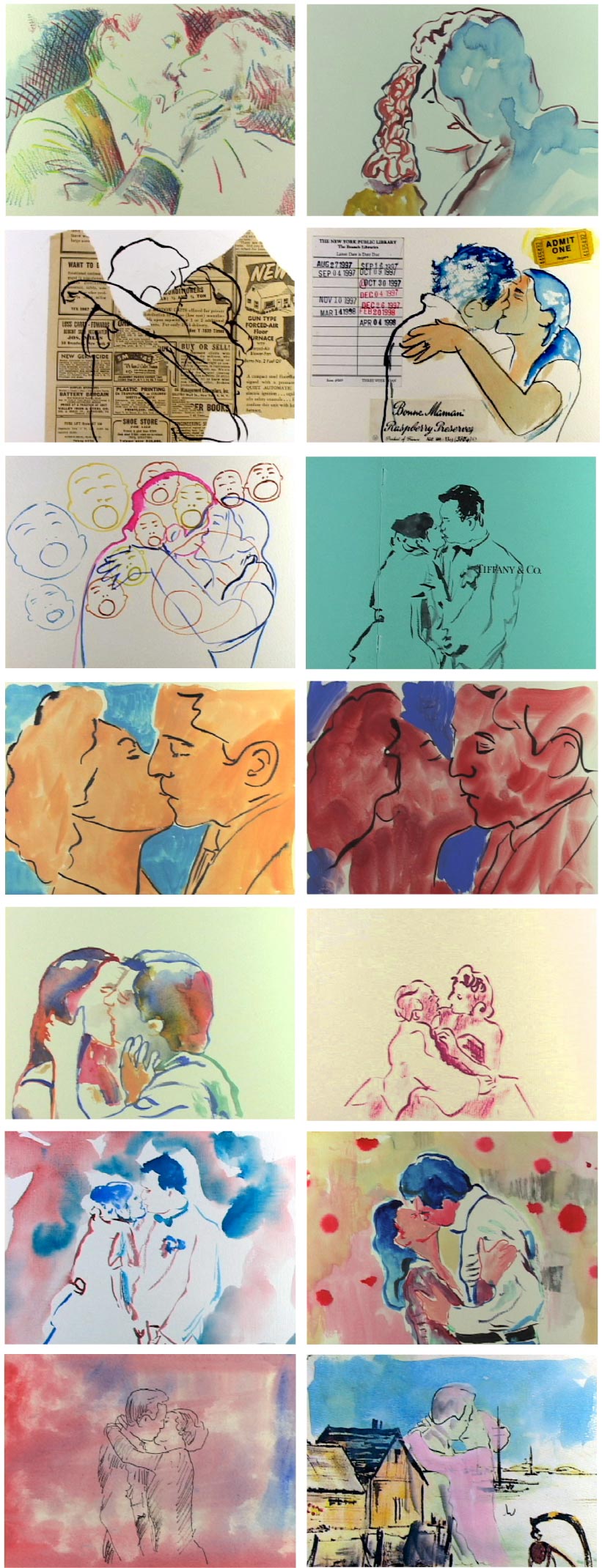
Jeff Scher is a New York based artist who runs The Animated Life blog at the New York Times. He creates animated films from his art work, for example, Tulps with both paintings (see right) and a movie.

His most recent Animated Life film is entitled ‘All the Wrong Reasons.’ As he describes this movie:

“Everyone makes experimental films when they dream. Dreams are picture-driven, non-linear quilts of movie-like moments sprinkled with cryptic epiphanies… “All the Wrong Reasons’ is an experiment in making a film that feels as if it has percolated up from the subconscious; a dream you can watch with your eyes open. It’s one of those big cathartic dreams, a labyrinth of fleeting moments full of metaphor and mischief. I wanted it to feel like a bumpy roller coaster ride in and out of the dark side of the brain where all the wrong reasons reside. And, as with all dreams, the meaning and significance are open to interpretation.”

Here’s the first minute or so on a YouTube piece, but I recommend going to his blog to watch the full three minute feature.

What most struck me with this film is how much closer Scher is to the quick of life and culture than most anthropologists, with our theories of symbols and meanings and post-modern discourses. All of that is almost too politically correct. Scher paints us something else, a labyrinth of metaphor and mischief, interpretations that get us at the wrong reasons behind meaning and significance, a place where a lot of us live everyday.

What makes humans unique?

Photo by JoProf. Michael Tomasello, co-director of the Max Planck Institute for Evolutionary Anthropology, whose work on chimpanzees and human children, on the biological capacity for culture, and a range of other subjects, must place him among the most important contemporary thinkers using comparative primate data, asks ‘How Are Humans Unique?’ in a recent piece for The New York Times‘ Idea Lab.

As Tomasello suggests, many things that we thought once definitively marked the difference between humans and other species, have gradually been found in evidence in other species — tools, deductive learning, language, even certain patterns of anti-social behaviour suggesting war and the like. The result is, for some, an uneasy sense that we might not be so different from other animals, and for others, a satisfaction that humans might be thought about using analytical frames developed with other species.

One thing that Tomasello points out very well is that many of humans’ cognitive advantages over other intelligent animals are ‘products of collective cognition,’ that is, not so much just an individual’s ability as the ability of an individual invested with the collective creativity and mental tricks invented by previous generations of humans.

Continue reading “What makes humans unique?”