Neuroanthropology.net just broke through the 1,000,000 visits mark! We’ve done that in three years. Our very post came in December 2007.
Even though Greg and I have moved over to Neuroanthropology PLoS, this site has continued to generate impressive traffic since September 1st. Here are some of the posts that got us over the top:
We agree it’s WEIRD, but is it WEIRD enough?
-Greg dissects the excellent study by Henrich et al. that took psychologists to task for basing claims about universal psychology using samples of college students
Inside the Mind of a Pedophile
-Absolutely incredible comments on this post, as readers continue to debate pedophilia, the people who have done it, and the children and families who have suffered from it
Life without language
-Author Susan Schaller’s work with a profoundly deaf immigrant who grew up without sign language, and an exploration of what it is like to live without language
It’s hard to believe that we’ve had 1,000,000 onsite visits in three years, plus all the other people who’ve read this site through Google reader or other rss feeds. When we started, we never expected to have such success with this site. So thank you!
And now we’re doing the same great stuff over on Neuroanthropology on PLoS. Here are five of our top posts since September 1st:
Anthropology, Science, and Public Understanding
-The American Anthropological Association dropped the word “science” from the mission statement included in the association’s long-term plan, and the media and blogosphere erupted. Here’s the post that kicked off Neuroanthropology’s extensive coverage of the controversy
An Interview with Mark Changizi: Culture Harnessing the Brain
-Cognitive scientist Mark Changizi gives us his inside view of how culture and brain evolved together, with an inside glimpse into his forthcoming book Harnessed: How Language and Music Mimicked Nature and Transformed Ape to Man
The Culture of Poverty Debate
-The controversial Culture of Poverty idea has made a comeback. Here’s coverage of the good and bad about the media reports and research on the renewed look at the links between culture and poverty
So far, over 1,200 people have read my post about The Wilberforce Award, but that’s not enough. It concerns me that only 550 or so people are fans of the facebook group “Dick Smith’s Wilberforce Award“, and that almost 4000 people are fans of a group called “What’s with the sudden overpopulation of wannabe ‘rappers’ ??!!” We need action and education. Or maybe we just need a rapper to bring lyrics about overpopulation to the world stage. Maybe someone like Matt Chamberlin, or… um… maybe not… I think I’m more partial to someone like Imogen Heap spreading the message with inspiring music and splendid visuals… But Matt’s video clip is a comic and engaging way to raise awareness nonetheless.
Talking about popular music and population growth reminds me of my favourite Indonesian singer, Rhoma Irama the king of Dangdut music—a popular style of music in Indonesia. When I was doing my fieldwork in Indonesia during 2007-2009, people would laugh when I told them that I liked the music of Rhoma Irama. They laughed even harder when I tried to sing any of his songs. Rhoma Irama was a huge star in Indonesia during the 70s and 80s. In 2007, locals didn’t expect a foreigner in his twenties to enjoy Dangdut music, let alone Rhoma Irama. But talking about Rhoma Irama’s music was a quick and easy way for me to find common points of interest with people in the places I was working. In 1977, Rhoma Irama released a song called “135million” that was about the number of people living in Indonesia and their many ethnic origins. The song still enjoys popularity, but people often joke that the lyrics need to be constantly changed. And really, every year, the lyrics need to be changed. By 1980, the population of Indonesia had grown to 147.5million and today the population is approaching 235million. When you have lived in the shanty towns of Indonesia, the overcrowded villages of the highland regions, and the poverty-ridden cities of the coast, you see first-hand the effects of rapid and unsustainable population growth. (Interested in Indonesia and the developing world? Read more about Globalisation and Ethics in Indonesia, and Globalisation, Ethics and Wellbeing).
Three websites that I highly recommend to everyone interested in birth rate, life expectancy, and population growth is the new Public Data Explorer available through Google; Gapminder for an amazing array of publicly accessible data; and Poodwaddle World Clock for an engaging site with the most up to date statistics of our times (pun intended). Mixing design, statistics, and experience in global development, Hans Rosling delivers a fantastic presentation on global health for the TEDtalks available through YouTube. I urge you to watch it, you will not be disappointed.
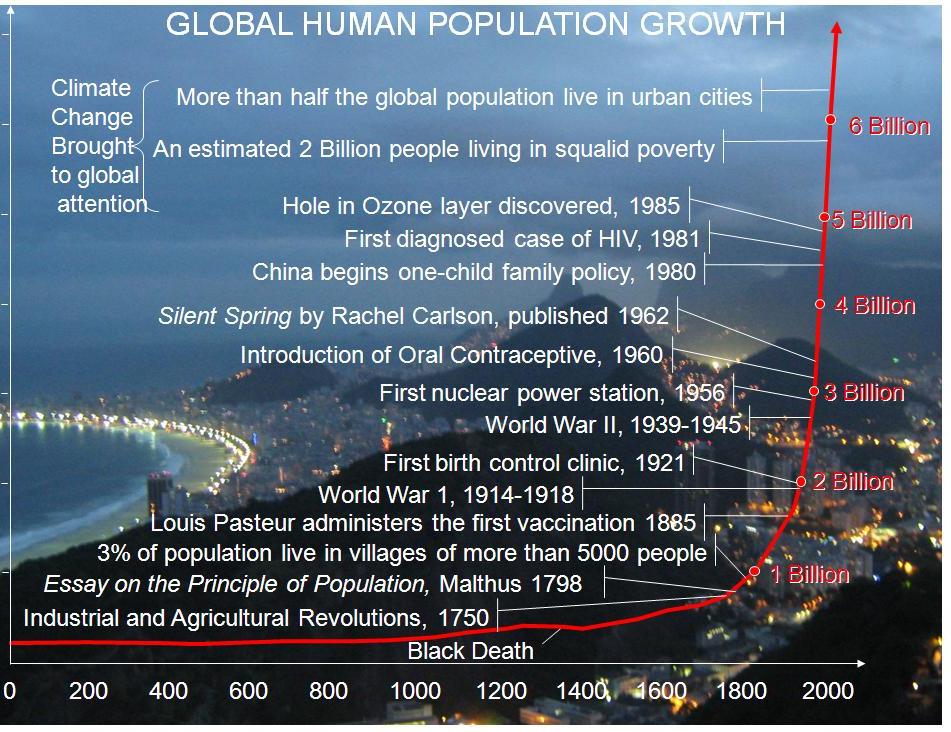
At Macquarie University, I have been teaching for a subject on Human Evolution and Diversity. One of the rooms we use is an experimental education facility where one wall is entirely covered with whiteboad paint. That means that you can use the entire wall as a giant whiteboard. In the final tutorial of the year, I drew a line starting at a power-socket in the bottom left-hand corner of the wall, continued along the skirting board at the base of the wall, and then abruptly curved upwards at the right end of the wall. With the students, we plotted dates, important developments in medicine and technology, and population figures. Starting somewhere around 7million people pre-agriculture some 20,000 years ago, students were amazed to see just how suddenly population has soared since 1500AD (only recently) and peaked at 7billion people at the top right hand corner of the room. Their faces grew from excitement at the beginning of the tutorial, to astonishment at the end of the tutorial. One of the most interesting discussions was about whether or not we owe China carbon-credits for the one-child policy. After vibrant discussions in all of my tutorial classes, there was a firm consensus that a multi-pronged, interdisciplinary and multi-sector effort was required to successfully implement steps to a sustainable future. Next year, we will continue a study group about sustainable populations for interested students. Our first venture will be to update the information contained in the chapter on “Mining Australia” in Jared Diamond’s illuminating book, “Collapse”.
For those of you who are interested, I have written an article looking at Population growth, urbanisation & pollution in the developing world, which has been published by the postgraduate journal, NEO: Journal for Higher Degree Research Students in the Social Sciences and Humanities, Volume 3, 2010. This article is in English and French and has received fantastic support and feedback from my friends and colleagues in the Amicale des Centres Internationaux Francophones. Merci a vous tous! One of the ideas I raise in this article is the cheap production and distribution of the contraceptive pill to women who wish to use it. Now that the pill is off-patent, it means that we could turn this idea into a reality. And, in light of recent research highlighing the enormous health benefits the pill offers women, this idea becomes even more of an ethical imperative. Contrary to popular and misplaced belief, the pill has actually been proven to have a raft of health benefits. See this TVNZ special for more.
Dick Smith’s million dollar prize is for a solution at home, in Australia. How can we organise our economy, be more strategic about skilled migration, and simultaneously accomodate for an aging population? I recommend following the developments of the Population Puzzle on facebook and Dick Smith’s website. And of course, stay tuned to our neuroanthropology blog for more. As soon as I finish my PhD on cultural evolution, I plan to turn my attention to the question of a sustainable future for the country I call home.

 Neuroanthropology