 Carol Worthman, a mentor of mine at Emory University and a real leader in doing neuroanthropological research (even if she might call it “biocultural”), has two recent articles out that I really want to highlight.
The first is The Ecology of Human Development: Evolving Models for Cultural Psychology. Here is the abstract, part of a whole special issue in the Journal of Cross-Cultural Psychology on the work of the husband-wife team John Whiting and Beatrice Whiting:
The Whiting model aimed to provide a blueprint for psychocultural research by generating testable hypotheses about the dynamic relationships of a culture with the psychology and behavior of its members. This analysis identifies reasons why the model was so effective at generating hypotheses borne out in empirical research, including its foundational insight that integrated nature and nurture, its reconceptualization of the significance of early environments, and its attention to biopsychocultural dynamics active in those environments.
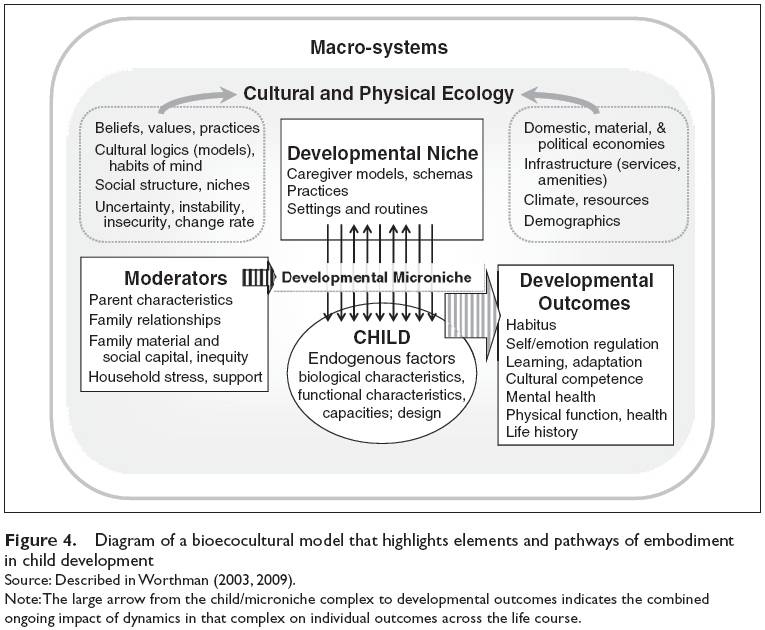
Implications and the evolution of the ecological paradigm are tracked through presentations of three current models (developmental niche, ecocultural theory, bioecocultural microniche) and discussion of their related empirical literatures. Findings from these literatures converge to demonstrate the power of a developmental, cultural, ecological framework for explaining within- and between-population variation in cultural psychology.
The figure above is from this paper, and represents Carol’s own model for understanding human development. But the real point that Carol wants to make in emphasizing these three models goes as follows:
All of these models share a concern for how the cultural ecology of affect and affect regulation drive psychobehavioral development, competence, and well-being or health. Whoever has looked has found linkages among cultural practices, stress physiology, and emotion regulation. Note that each of these models foregrounds the development of emotion and emotion regulation and de-emphasizes classic knowledge acquisition. Although there are important reasons for this emphasis (Damasio, 2005), a reconsideration of what constitutes “knowledge” and more systematic investigation of the linkages between emotion and knowledge might prove valuable (588).
The second article is Habits of the Heart: Life History and the Developmental Neuroendocrinology of Emotion. This article was part of a special issue on Advances in Evolutionary Endocrinology in the American Journal of Human Biology. Here is Carol’s abstract:
The centrality of emotion in cognition and social intelligence as well as its impact on health has intensified investigation into the causes and consequences of individual variation in emotion regulation. Central processing of experience directly informs regulation of endocrine axes, essentially forming a neuro-endocrine continuum integrating information intake, processing, and physiological and behavioral response. Two major elements of life history—resource allocation and niche partitioning—are served by linking cognitive-affective with physiologic and behavioral processes. Scarce cognitive resources (attention, memory, and time) are allocated under guidance from affective co-processing. Affective-cognitive processing, in turn, regulates physiologic activity through neuro-endocrine outflow and thereby orchestrates energetic resource allocation and trade-offs, both acutely and through time. Reciprocally, peripheral activity (e.g., immunologic, metabolic, or energetic markers) influences affective-cognitive processing.
By guiding attention, memory, and behavior, affective-cognitive processing also informs individual stances toward, patterns of activity in, and relationships with the world. As such, it mediates processes of niche partitioning that adaptively exploit social and material resources. Developmental behavioral neurobiology has identified multiple factors that influence the ontogeny of emotion regulation to form affective and behavioral styles. Evidence is reviewed documenting roles for genetic, epigenetic, and experiential factors in the development of emotion regulation, social cognition, and behavior with important implications for understanding mechanisms that underlie life history construction and the sources of differential health. Overall, this dynamic arena for research promises to link the biological bases of life history theory with the psychobehavioral phenomena that figure so centrally in quotidian experience and adaptation, particularly, for humans.
In this second article, Carol is tying her work back into evolutionary theory. If the first took up more the cultural/psychological side, then here we are grounded in the mechanisms and ideas of biological anthropology. She writes here:
Given the evidence of gene-environment interactions and developmental effects discussed above, combinations of history and circumstance will condition the phenotypes generated from the genetic structure, and thus influence the impact of that structure on corresponding experience, welfare, behavior, and the balance of selective pressures upon genetic diversity. Such gene-environment interactions and their consequences for function and welfare deserve investigation across a wide range of human cultures and conditions. Such study bears exciting possibility for unlocking dynamics among culture, social conditions, the nature and distribution of social niches, and selection pressures operating on allelic variants (779).
Link to citation/abstract for Carol Worthman’s The Ecology of Human Development: Evolving Models for Cultural Psychology.
Link to citation/abstract for Carol Worthman’s Habits of the heart: Life history and the developmental neuroendocrinology of emotion.
Update: You can see Carol lecture on Habits of the heart: Life history and the developmental neuroendocrinology of emotion regulation here.

 Neuroanthropology