
“I’m so much cooler online…Yeah I’m cooler online…”
– Brad Paisley, Online
By David Patterson, Elizabeth Kuzmich, Francis Verhaegen, and Natalie Leopold
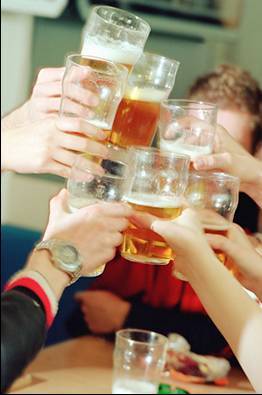
Why do they do it? Why do otherwise smart and savvy college and high school student post photos of themselves drinking and partying on Facebook and MySpace? To the right is just one. There are many more, some of them a lot more, um… revealing than this one.
Facebook/MySpace and the pictures posted on these websites represent a microcosm of social life. It is true that college students drink more often and in higher quantities than any other age group. Their lives include class, work, homework, club meetings…and partying. Many times, pictures of fraternity parties and keggers do not portray college students accurately. In other words, these students choose to portray only certain aspects of their lives on the Internet.
Thus, the pictures posted on Facebook/MySpace only represent some of these activities, specifically partying. For the same reason that website profiles of older adults often feature their wives and children, the profiles of college students feature what they believe is the most interesting, or ‘coolest,’ part of their life – having fun while partying and drinking.
Pictures of drinking and partying are interesting to their peers. The college social scene revolves around attending bars and fraternity parties. Just as the public looks to celebrities for cues on what to wear, where to go, and how to act, young adults look to their peers to see what are the best parties and activities, which are illustrated on Facebook/MySpace. It is unlikely that a college student would post a picture of himself or herself in the library or working at the ice cream shop.
Facebook/MySpace allows for the creation of new or altered identity and the presentation of this identity to others. Individuals can portray themselves as social, attractive, and popular by posting pictures of themselves surrounded by friends at a party. In theory, this makes them more desirable to the other sex and ‘cooler’ to their peers.
Examining the Profiles
In order to take a closer look at the prevalence of alcohol-related pictures in Facebook and MySpace profiles, 25 Facebook profiles and 25 MySpace profiles were randomly selected from a large pool of male and female individuals using a random numbers generator. The users’ ages varied from 17 to 25, essentially the average aged college students. From these profiles, the photo albums were inspected to determine whether they were alcohol or party related. Pictures containing beer cans, bottles, or handles of liquor or those taken in a bar or party setting or other miscellaneous drinking activities counted towards an “alcohol-related” picture or photo album.
Continue reading “Why Do They Do It? Portrayals of Alcohol on Facebook and MySpace”
 Neuroanthropology