Neuroanthropology

For a greater understanding of the encultured brain and body…

Archive for April, 2009

Escaping Orientalism in cultural psychology

Posted by gregdowney on April 30, 2009

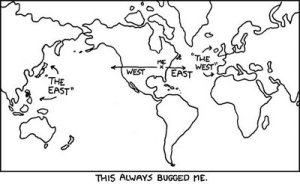
eastwest1In a recent article in American Psychologist, Adam Cohen (2009) suggests that a number of fields in psychology have taken up the study of culture, but the results, although interesting, have been limited by what sorts of ‘culture’ have been investigated. As Cohen (2009:194) writes:

A person reading these literatures could be excused for concluding that there is a very small number of cultural identities (North American vs. East or Southeast Asian), that vary principally on the dimensions of individualism–collectivism or independent–interdependent self-construal—whether people are seen as inherently independent from others or whether social roles are most important in defining the self.

In this post, I want to provide a bit of a bibliography of some of the literature fast emerging on cultural difference in psychology, neuroimaging, and related fields, but also focus a bit on the consequences of this limited imagination in considering cultural difference, the almost exclusive focus on East-West contrasts. Just because I love a bit of controversy with my breakfast, I’ll suggest it’s a form of what Edward Said has called ‘Orientalism.’

Although Cohen brings up the issue and offers a few suggestions for how the problem might be addressed, I think his prescriptions would herald more of the same sickness, although perhaps spreading the infection to more hosts. That is, Cohen puts his finger on a serious problem in the psychological study of culture, but the prognosis won’t improve much unless we actually understand the root of the problem: it’s not studying Europeans (and European-Americans) and Asians (and Asian-Americans) that’s causing the whole problem. Part of it is misunderstanding what is being studied in the first place when cultural difference is under the lens.

This post is based on part of a talk I gave on Tuesday to the Centre for Cognitive Science (MACCS) here at Macquarie. When I got into the subject, I realized it was far more than I could possibly share in a 50-minute presentation, so I thought I’d post it here.

Read the rest of this entry »

Posted in Brain imaging, general, Human variation | 7 Comments »

Wednesday Round Up #61

Posted by dlende on April 29, 2009

So after the favs, it’s some evolution (hobbits and phalluses, anyone?), then anthro and neuro, onto education and finishing off with some stuff on Colombia. Enjoy!

Top of the List
fibroblast-and-nanowires
Courtney Humphries, Untangling the Brain: From Neuron to Mind
Feature article from Harvard Magazine which addresses the question, “how do individual neurons link to one another in networks that somehow result in complex brain functions?”
The striking picture at right leads off the article, and shows a human fibroblast on a bed of nanowires. They also have some good online videos about simple creatures and how they navigate the world.

Roberto Casati, Book Review: The Art Instinct by Dennis Dutton
Culture & Cognition takes on the claims of art by evolution while preserving sympathy for the overall evolutionary effort. For the fun version, see Colbert’s interview with Dutton – art for propagation!

Heather Tompkins, Derek Albeck
Street Art! Skulls meets urban portraiture! Hat-tip to Sue!

The Neurocritic, Neural Correlates of Admiration and Compassion and Envy and Schadenfreude
Both critical and informative on the blow-up of novel research and media sensationalism

Declan Butler, Web Usage Data Outline Map of Knowledge
Pdf of a recent Nature News piece – here’s what impressed me about this take on the PLoS paper, “A striking difference in the usage maps is that journals in the humanities and social sciences figure much more prominently than in citation-based maps. Along with journals in some other fields, such as psychology and the environment, they also emerge as gateways between clusters that are otherwise poorly connected, and so act as key bridges between disciplines.”

Evolution

Read the rest of this entry »

Posted in Wednesday Round Up | Leave a Comment »

Anthropology on Cambridge DSpace

Posted by dlende on April 28, 2009

dspace-anthropology
One of our readers, Laurence (thanks!), pointed out a great resource yesterday, Cambridge DSpace (Digital Space), the university’s “institutional repository… to facilitate the deposit of digital content of a scholarly or heritage nature.”

Laurence sent us the link for all the video lectures and other materials under “Department of Social Anthropology” at Cambribge. These resources include interviews with a wide range of scholars, from Paul Rabinow to Colin Renfrew and Simon Schaeffer and many others. This section shows 471 results, so plenty to explore.

There is a whole range of intellectual communities on Cambridge DSpace, from horse paleopathology (only 1 item, but still I had to mention it!) to the Literary and Linguistic Computing Centre. The Department of Economics has their collection of working papers up, including this 2004 one on bounded rationality and neural networks. But it really seems that the Department of Social Anthropology has taken the greatest advantage of DSpace, so go explore.

Posted in Links | 2 Comments »

Stimulating Encephalon

Posted by dlende on April 28, 2009

brain-stimulation
Brain Stimulant is hosting the 69th edition of Encephalon, the mind/brain blogging carnival. This time we’ve got free will, art and cognition (and tests too!), and kittens.

Posted in Links | Leave a Comment »

What Is Social Anthropology? by Alan Macfarlane

Posted by dlende on April 27, 2009

I found the following video quite good – rather like getting to sit down in a tutorial and listen to a master speak. Your tutor is Alan Macfarlane, professor in the Department of Social Anthropology at the University of Cambridge.

If you’re interested in comparing the master class to the group document, here’s the Wikipedia entry on social anthropology.

Macfarlane’s most recent book is Letters to Lily: On How the World Works, where he brings together his work as historian and anthropologist to answer his granddaughter’s questions, What is love? Why are families so difficult? How do we get justice? How well does democracy work? Who is God? What makes us individuals? And why are we here in the first place?

You can get the full list of questions and some background and a taste of how he answers the questions at Macfarlane’s website.

Macfarlane has written many books, including The Glass Bathyscape: How Glass Changed the World (publishing in the US as Glass: A World History), written with Gerry Martin. The two published a synopsis of the book in Science, Beyond the Ivory Tower: The World of Glass. Macfarlance has also provided us a set of video clips on glass, its making and uses, which highlight the conclusion to the Science piece:

“The different applications of glass are all interconnected–windows improved working conditions, spectacles lengthened working life, stained glass added to the fascination and mystery of light and, hence, a desire to study optics. The rich set of interconnections of this largely invisible substance have made glass both fascinating and powerful, a molten liquid that has shaped our world.”

Also, with a hat-tip to Kerim at Savage Minds, Macfarlane has interviewed an extraordinary range of social scientists in his “Ancestors” page, from Frederick Barth to Roy Wagner, with full audiovisual files available.

Posted in Cultural theory, Video | 1 Comment »

Four Stone Hearth Out

Posted by dlende on April 24, 2009

four-stone-hearth
A Primate of Modern Aspect (which has the best url ever, zinjanthropus.wordpress.com) is hosting the anthro carnival Four Stone Hearth.

Lots of good stuff – language and culture, online ethnography, female choice over male provisioning, good and bad news about primate conservation, and more. A real four-field one! It’s great.

Posted in general | Leave a Comment »

Wednesday Round Up #60

Posted by dlende on April 22, 2009

Besides the normal, neuro (enhancing!) and anthro, there’s a round-up on stuff related to addictions – drug war controversy, video games, sex, social learning, and even some contingent incentives for treatment.

Top

The Neurocritic, The Neurology of Twitter
Oh you critic you! See, I did it in 140 characters. Well, less!

Christine Rosen, It’s Not Theft, It’s Pastiche
The Wall Street Journal reviews the new book, My Word! Plagiarism and College Culture, by my great colleague Susan Blum, on routine plagiarism by students and the college culture that helps make sense of that

Strange Maps, US States Renamed for Countries with Similar GDPs
Thanks to Paul Mason and his dad for this one. The US is 50 countries in one – and now there is a map that shows off the economics of it.

Eugene Raikhel, Ian Hacking on Commercial Genome-Reading
Somatosphere provides a good overview on an on-going Net discussion from some heavy hitters. And the NY Times just reported that Genes Show Limited Value in Predicting Diseases

American Anthropological Association, April AN Addresses Visual Ethics and Multisensory/Multimedia Anthro
The latest Anthropology News, and for once you can just get the pdfs online.

Neuro

Margaret Talbot, Brain Gain: The Underground World of “Neuroenhancing” Drugs
The New Yorker on this emerging synergy of demand, competition, self and neuro-medicine. For some good commentary, see Mind Hacks.

Read the rest of this entry »

Posted in Wednesday Round Up | Leave a Comment »

BIG NEWS: First Neuroanthropology Conference!

Posted by gregdowney on April 21, 2009

We’ve hinted at this, but now it’s confirmed: the first Neuroanthropology Conference will be held 8 October 2009 at the University of Notre Dame in South Bend, Indiana. Daniel and I are very pleased to be able to announce, ‘The Encultured Brain: Neuroanthropological Explorations.’ We’ll have lots of news and information, including how to register and get involved, coming soon, but we wanted to post notice of the upcoming conference as soon as possible so that you can have a chance to pencil it into your calendars.

Update: You can now go to our official announcement, including details on submitting abstracts and registering.

Due to generous support from the Lemelson/Society for Psychological Anthropology Conference Fund as well as the Institute for Scholarship in the Liberal Arts, the Graduate School, and the College of Arts and Letters at Notre Dame, this will be a bargain of a conference, registration fees basically coming back to you immediately in the form of eats and drinks.

Graphic from NYTimes, by Yarek Waszul

Graphic from NYTimes, by Yarek Waszul

One main part of the schedule will facilitate a kind of collective brain-storming, make connections (both mental and practical) meeting, rather than the standard anthropology panel set-up, where just a few people present 15 minute versions of their research.

We will have two keynote presentations, as well as a lot of ‘speed presentations’ in which participants will be able to briefly (about five minutes) talk to the whole assembled conference about what they are working on or would like to work on. We will have pre-printed message pads to allow the whole conference to share thoughts, as well as ample chances during breaks to grab the person you just heard share a great idea. Think of it as intellectual speed dating, in which a larger percentage of conference participants get to talk to the whole conference, rather than just to the small group that choose to attend your session.

There will also be an ongoing poster session for presenters so that we really get an opportunity to network in this emerging area of research. So much of what we hope to do is to create conversations over the fences that separate our respective disciplinary backyards, so we’re going to do our best to get people in touch. There will also be a roundtable on research methods for breaking new ground in neuroanthropology.

In addition, we’ll have keynote lectures by — drum roll, please — Prof. Patricia Greenfield of UCLA and Prof. Harvey Whitehouse of Oxford University. [Fixed that link...] We’re going to have profiles posted on both keynote speakers in the near future, but suffice to say that Prof. Greenfield is Distinguished Professor of Psychology at UCLA, heavily involved in (and former Director of) the FPR-UCLA Center for Culture, Brain, and Development as well as the current Director of the Children’s Digital Media Center, Los Angeles (CDMCLA). I won’t even try to summarize her long record of interesting research on the brain, psychology, cross-cultural variation, child development, education, and media (I’ll try that in a later post, unless I can talk Daniel into it), but if you want a jump start, her academia.edu website has 16 of her papers available.

Prof. Harvey Whitehouse of the University of Oxford is also Head of the School of Anthropology and Museum Ethnography at Oxford, Head of the Institute of Social and Cultural Anthropology (ISCA), Director of the Centre for Anthropology and Mind (CAM), and a Fellow of Magdalen College. Although he has written widely on religion, evolution, and his ethnographic research in Papua New Guinea, of late he has been one of the leaders in integrating cognitive, evolutionary, and anthropological research in Europe, especially on the subject of religion. Again, if you want to get the jump on our profiles, there’s a substantial list of his books and other publications available at the ISCA website.

We will also be having a number of invited guests, whom we’ll introduce as we get confirmations. This is just the first announcement, and we’ll be posting more soon, including registration information.

Posted in Conferences | 5 Comments »

Is Your Brain Green?

Posted by dlende on April 18, 2009

green-lantern
Why Isn’t the Brain Green? asks Jon Gertner in the feature article of the “Green Issue” in this week’s New York Times Magazine. The issue is worth a visit alone for the striking photos, where the Momix Dance Troupe form vivid images of the head and the brain. But Green Lantern is going to come in handy.

So who wants to know why the brain isn’t green? CRED – Center for Research on Environmental Decisions – where they use behavioral research and decision science to understand “the green mind” (or lack thereof). As seems de rigeur today, any topic where we don’t act on the information available and seem to make irrational decisions is the target of this new decision science.

CRED has the primary objective of studying how perceptions of risk and uncertainty shape our responses to climate change and other weather phenomena like hurricanes and droughts. The goal… is to finance laboratory and field experiments in North America, South America, Europe and Africa and then place the findings within an environmental context.

So what are the problems? We’re bad at long-term decision making; we see environmental problems as far away from our everyday lives; we seem to have a “finite pool of worry” and make an occasional decision to help the environment while continuing on with our overall lifestyle.

Read the rest of this entry »

Posted in Decision Making, general | 4 Comments »

Who you callin’ a ‘neuroconstructivist’?!

Posted by gregdowney on April 17, 2009

brain_construction1Intellectual labels are always a tricky business, necessary for talking about ideas and suggesting that a theorist is in a particular ideological neighborhood. Yet, they can drag along so much baggage that they become self-defeating, evoking instant resistance or inevitable misinterpretation if poorly used. In the best of cases, they can help to create a clear identity for innovative work in an academic field, speeding the effort to carve out a space for ideas in a cluttered terrain of thought. Deployed well, they can help to clarify and orient us; applied clumsily, they become intellectual invective, prematurely close off discussion or debate, and substitute labeling for thinking.

Today, I want to write briefly about ‘neuroanthropology’ as a badge, but spend more time on ‘neuroconstructivism,’ as it’s a term that sometimes gets associated with the sort of research and thinking that we are advocating here at Neuroanthropology.net. In a sense, this piece is written for non-anthropologists, to help them understand why they might get a really strange reaction from an anthropologist colleague if they start talking excitedly about new ‘neuroconstructivist’ perspectives.

We’ve obviously decided that ‘neuroanthropology’ is one of the labels that we find helpful. We stand by the neologism, even though some of our readers have described our choice of terms ‘deplorable,’ and we’ve sometimes had to struggle against the term’s use elsewhere. For example, Oliver Sachs, the wonderful chronicler of the lived worlds of people with severe brain lesions, often calls himself a ‘neuroanthropologist,’ as Jovan Maud at Culture Matters pointed out to me and Daniel highlights in a recent, more thorough post on the relation of what we’re doing to what Sachs has done (see also Neuroanthropology).

Read the rest of this entry »

Posted in Cognitive anthropology, Developmental psychology, general, Neural plasticity | 5 Comments »

 
Follow

Get every new post delivered to your Inbox.

Join 110 other followers