
Do psychotherapists now have a new trick? Or is it all smoke and mirrors? The New York Times reports today on Standing in Someone Else’s Shoes, Almost for Real, where neuroscientists have shown that “the brain, when tricked by optical and sensory illusions, can quickly adopt any other human form, no matter how different, as its own.”
The article “If I Were You: Perceptual Illusion of Body Swapping” by the Swedish researchers Henrik Ehrsson and Valeria Petkova appears this week in PLoS ONE, and is ably summarized over at Neurophilosophy. You can also read Ehrsson’s previous article on the virtual arm illusion and his Science piece on the experimental induction of out-of-body experiences.
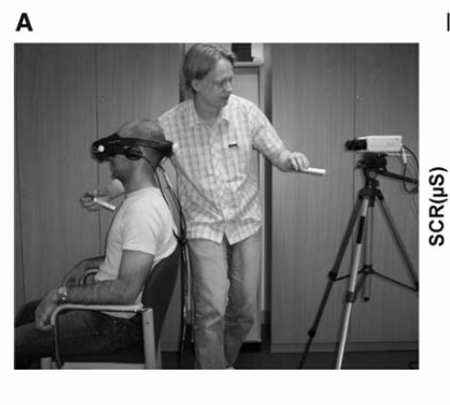
The approach in all of this research is rather simple. You can see the out-of-body experiment design pictured to the right. Body swapping adds another person with goggles.
A subject stands or sits opposite the scientist, as if engaged in an interview.. Both are wearing headsets, with special goggles, the scientist’s containing small film cameras. The goggles are rigged so the subject sees what the scientist sees: to the right and left are the scientist’s arms, and below is the scientist’s body. To add a physical element, the researchers have each person squeeze the other’s hand, as if in a handshake. Now the subject can see and “feel” the new body. In a matter of seconds, the illusion is complete.
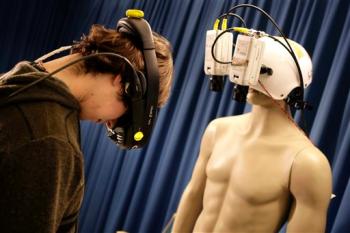
This “switching” happens because the brain is literally embodied – after growing up with this particular body, it’s a fair assumption to assume that one’s eyes and one’s hand are getting feedback about the same interactive phenomenon. For a first-person view of this, see Karl Ritter’s AP article today on the body-swap illusion, which includes this photo of the two-goggle set-up.
Ehrsson is excited about being able to trick the brain in this way: “You can see the possibilities, putting a male in a female body, young in old, white in black and vice versa.” The NY Times article pushes the uses body swapping can have in therapy.
 Neuroanthropology