Anthropologies

In today’s New York Times Mark Leibovich writes on the contrasts between Republican and Democratic events in “At Rallies of Faithful, Contrasts in Red and Blue.” Differences in dress, behavior, language, music and more are highlighted, with some recognition of the similarities too. But it was really this line from Leibovich that got my attention:

What can we learn from a close-in view of Democratic and Republican events at the end of a bitter, exhilarating campaign? It has become a cliché to say that the country is “divided,” but the anthropologies displayed at 11 campaign stops in recent days offer glimpses of partisan America.

I have never seen “anthropologies” used in that way, as a noun to capture what generally anthropologists try to gloss under the rubric of “culture.” For US anthropologists, “anthropologies” might mean the four or five different fields we say fall under the discipline of anthropology – biological and sociocultural, linguistic and archaeology, with applied often thrown in for good measure.

I really like this use of “anthropologies,” and the fact that it got past the copy editors at the Times must mean that they assume it has enough common meaning for people to grasp some general concept behind it.

“Culture” has been a contested concept in anthropology for several decades now, but we haven’t really been able to settle on a better term for a holistic understanding of a way of life. Anthropologies seems a lot closer, especially when we can then evoke all the different fields to understand the lived anthropology of a place and time and people. No longer is it the -ology receiving emphasis, it is the anthro-.

With anthropologies, we can talk about ways of life and practices and embodiment and meaning, and not keep assuming that somehow a symbolic structure or an inequality or a set of genetics is the thing to use to understand that way of life. Rather, it demands the sort of interdisciplinary engagement already seen in the word itself – anthropologies.
Animal Color

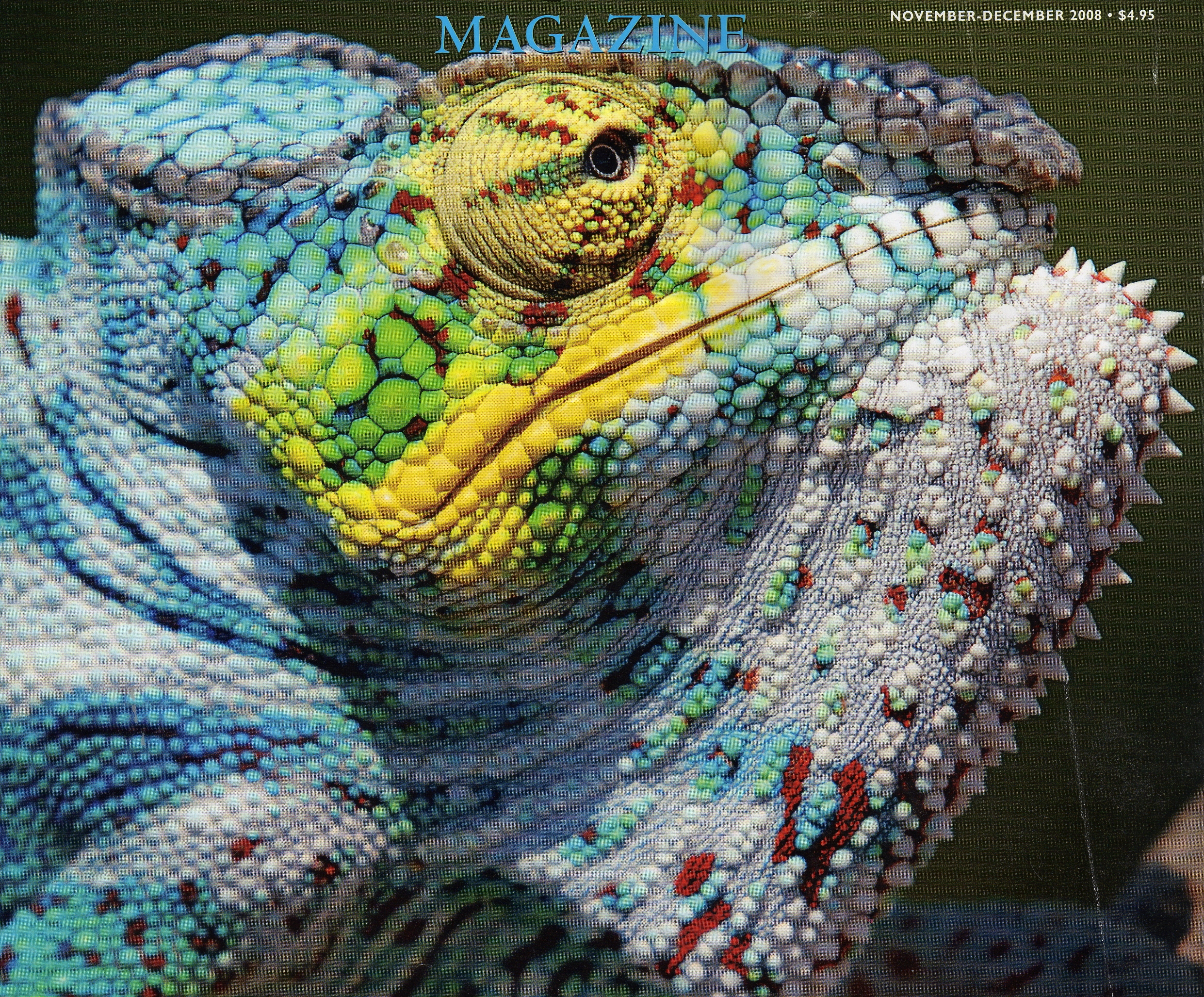
The cover of the November-December Harvard Magazine features this magnificent photo of a panther chameleon from Madagascar (sorry for the slight crease from the scan; the original photo is by Paul Bratescu). That photo introduces us to the feature article Animals Speak Color.

The article is full of striking photos, including this one below of this colorful nudibranch (a type of mollusk). You can go to the website to see them all or download the pdf. If you want the live experience, the article is based on the new exhibit The Language of Color at the Harvard Museum of Natural History. In lieu of that, the magazine gives us a video tour.

In the animal kingdom color serves to warn, camouflage, advertise, and compete. Sex drives a lot of that, showing off for mates, but so does poison, telling predators that this flashy little being is bad to eat.

The Harvard Museum of Natural History is home to the world-famous glass flowers, exquisite life-like reproductions. So it’s not jus the animal world getting in on the color game!

Cartagena Brings Food


Cartagena. The ceviche topped by a twist of plantain is from there. The sunflower-at-dusk building is the restaurant La Vitrola, tucked in beside the Spanish fortifications. Both are part of the NY Times article declaring Cartagena on the map for foodies and gourmets alike.

I’ve eaten at La Vitrola; my financier friend, fascinated by the restaurant, wanted to go there every night. La Escollera, salsa and rum and dancing, is just around the corner. But it’s not the best meal I have ever had in Cartagena. There was a small French restaurant, prix fixe, which produced an extraordinary menu the night my wife and I went there. Even that was no comparison to La Casita Vieja, a small joint in the center, long-closed, where I had one of those experiences I still tell stories about.

On the Caribbean coast the typical meal is sancocho de pescado, fish soup. And La Casita Vieja produced a long-simmered soup full of local fish and plantain and potato and cilantro, an extravagance in its richness and freshness. Trying to lure the tourists in, the soup was served in a large carved calabash with a spoon to match. But it was no tourist trap. The ceiling was low, the windows thrown open, and in the Cartagena heat, the fans thrummed and the smooth Colombian beer was the only thing that hinted at cool. I ate and ate that afternoon.

So if you are ever in Cartagena, sure, La Vitrola is a great place. But el sancocho, that’s the thing memories are made of.

With that introduction, here’s an eclectic foodie round up.

Michael Pollan, Farmer in Chief
What the next president should really do about our food industry; a great essay from the noted writer

Dan Sperber, Tasty Food for Anthropological Thought
Are there four universal tastes? And does anthropology and population thinking have anything to add? A new article in the Brain and Behavioral Sciences

Continue reading “Cartagena Brings Food”