
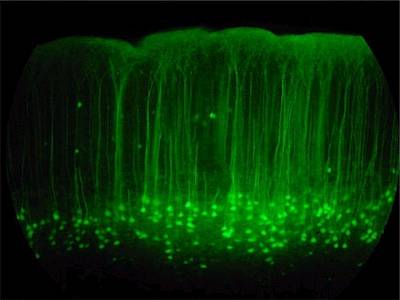
The latest edition of Encephalon is out over at Neuroscientifically Challenged. Fifty five times the mind/brain carnival has done its fortnightly thing. Oh rapture. So I found some cool emerald-colored neurons to celebrate the occasion!
Marc leads off with a video game post, and that’s got me hooked! It’s about the gaming professors Cheryl Olson and Lawrence Kutner, who have written the book Grand Theft Childhood: The Surprising Truth About Violent Video Games and What Parents Can Do. Using research, not accusations, the couple present a balanced view of the good and the bad of video games, and come down mostly on the good. So go to Sharp Brains for a great overview of their work.
Cognitive Daily has a post on condoms and teenage sexual behavior. As it happens, what matters here is not good intentions but having the damn thing at hand. Ah, the old anthropological dictum, what people say and what people do are often very different things…
Ever wondered what computational neuroscience is? Neuronism gives us the overview of this modeling approach.
And Mouse Trap gives us eight basic adaptive problems that animals face. They are: predators, eating the right food, forming relationships, helping children, helping kin, reading other people’s minds, and communication.
These eight come from two evolutionary psychologists, and are not the only way to parse evolutionary problems. Life history theory might focus on growth and the timing of reproduction and the importance of disease and immune function, all of which involve lots of brain/body interactions. An evolutionary-inclined neuroscientist might take a page from computational neuroscience above, and say that just getting accurate brain function (say, useful perceptions of the world) is a much more significant adaptive problem. Just more food for thought… Uh oh, that’s non-adaptive, shouldn’t food go into reproducing? And what about those condoms?
Anyway, head over to Neuroscientifically Challenged for these and more!

 Neuroanthropology