
At the Critical Neurosciences meeting in Montreal, Laurence Kirmayer brought up a great example of how research gets transformed and bastardized by the popular media. Here we have sociological research on the complex dynamics behind delinquency becoming the “biology-causes-everything” story.
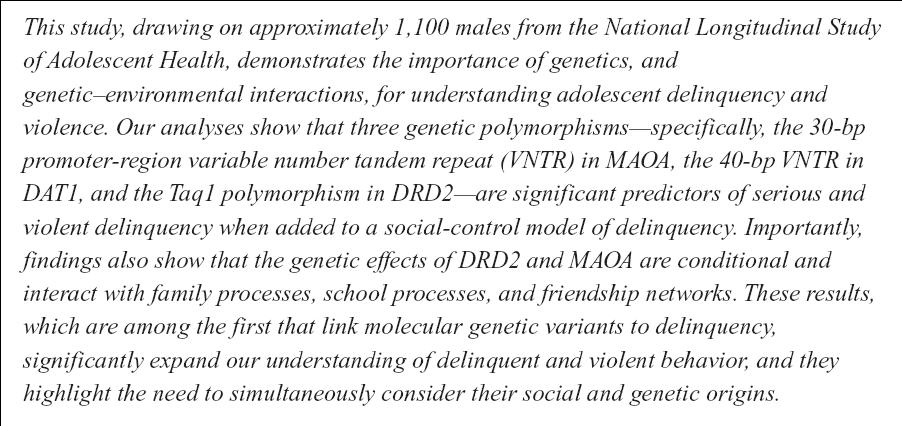
The original article is entitled “The Integration of Genetic Propensities into Social-Control Models of Delinquency and Violence among Male Youths” (big pdf; supplementary methods materials here) by Guang Guo, Michael Roettger and Tianji Chi at the University of North Carolina – Chapel Hill.
As a featured article in the American Sociological Review, the flagship journal of the American Sociological Association, this article had both a press release and an abstract prepared specially for the media. In other words, there were already digested materials ready for the media! No “misreading” of the original paper allowed.
The press release reads “Sociological Research Shows Combined Impact of Genetics, Social Factors on Delinquency,” with a minor highlight that indicates “Study is among first to tie molecular genetic variants to male delinquency.” The first sentence goes: “[this] sociological research… identifies three genetic predictors—of serious and violent delinquency—that gain predictive precision when considered together with social influences, such as family, friends and school processes.”
The media abstract is even clearer: “[The] genetic effects are conditional and interact with family processes, school processes, and friendship networks. ‘A stronger social-control influence of family, school, or social networks,’ the authors explain, ‘reduces the delinquency-increasing effect of a genetic variant, whereas a weaker social-control influence of family, school, and social networks amplifies the delinquency-increasing effect of a genetic variant’.”
Guang Guo goes on in the ASA media release: “Positive social influences appear to reduce the delinquency-increasing effect of a genetic variant, whereas the effect of these genetic variants is amplified in the absence of social controls. Our research confirms that genetic effects are not deterministic. Gene expression may depend heavily on the environment.”

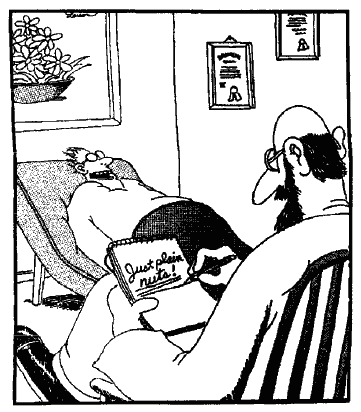
So how does Reuters, one of the premier reporting services in the world, present the article? “Study finds genetic link to violence, delinquency” reads the title. I’ve included the accompanying photo that comes directly below the title. The Reuters piece got posted at Scientific American, Yahoo and other places, while an even worse photo appears at a “European descent” site.
 Neuroanthropology