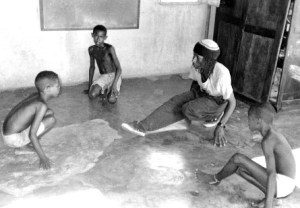
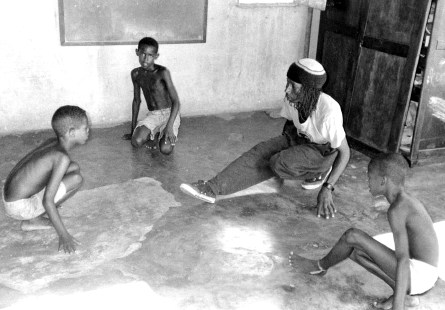
 I’m pleased that a piece I put together on coaching and physical education has appeared in the most recent edition of American Anthropologist. Entitled, Scaffolding Imitation in Capoeira: Physical Education and Enculturation in an Afro-Brazilian Art, it’s behind a subscription wall (sorry about that).
The article is part of my continuing attempt to understand the relation of mirror neurons to actual patterns of imitative cultural learning. The effort is pretty unambitious in comparison to some of the more sweeping declarations about mirror neurons, that they explain all sorts of human capacities. That is, I think some of the discussion of mirror neurons has sped on ahead of both the research and other studies of imitation, including its limitations and odd quirks, to declare that mirror neurons explain all sorts of human abilities. By focusing specifically on a setting where imitation clearly is in play — mimetic learning — I hope to create a model of brain, behaviour, interaction, and even ideology all in interplay to create ability in the individual actor.
Mirror neurons alone do not explain humans’ prodigious abilities in imitative learning; the macaques that first offered evidence of mirror neurons to the University of Parma team do not learn well through imitation. So we can’t just explain enculturation through imitation in humans by reference to mirror neurons. There’s got to be more to the story than mirror neurons. So to think about that, I’m looking specifically at motor learning in capoeira, my original ethnographic study, and am now moving to work on rugby coaching (if I can get some research support).
What I’m thinking is that this careful neuroanthropological modeling of enculturation will likely undermine certain accounts of what culture itself could be. That is, studying how we get encultured will demonstrate limits on what can be learned, how, and under what circumstances.
Continue reading “Mirror neurons: shameless plug redux & publishing regrets”

 Neuroanthropology