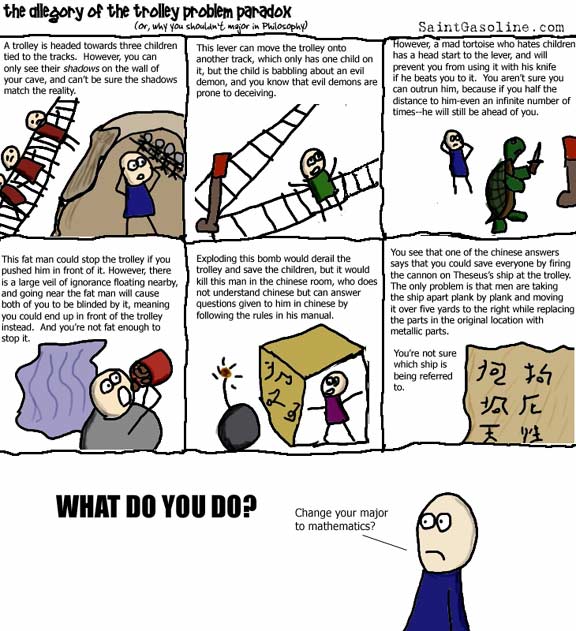
The Allegory of the Trolley Problem Paradox

Back in January we discussed the trolley problem when considering Pinker’s proposal for a moral instinct. But here’s a much funnier take on the whole issue! (Click on the image to make it larger if you can’t read the small lettering.)

The hat tip goes to the very cool Bioephemera, or biology + art (also see the old version here for more art & biology). That led me to Saint Gasoline, or a fine mixture of intellectualism and fart jokes, and their discussion of the trolley problem.

Migrated to neuroanthropology.net

We’re young and still experiencing some growing pains, but we’ve gone ahead and gotten our own domain. So if you’re reading this, hopefully you’ve notice that we’re now neuroanthropology.net. WordPress is still hosting the site, but we think that the new address will help us to continue to grow ourselves as a site for exploring the many intersections between anthropology and the brain sciences.

Expression and trauma

Just a brief note. I came across this press release from the UC of Irvine, Expressing feelings after trauma not necessary, research shows, based on work by psychologist Roxane Cohen Silver. As the press release details:

Talking it out has long been considered essential to recovering from a trauma. But new research shows that expressing one’s thoughts and feelings after a traumatic event is not necessary for long-term emotional and physical health, a finding that could change the way institutions devote money and resources to mental health services following collective traumas.

The research looked at the effects of the 11 September 2001 terrorist attacks and found that ‘individuals who communicated their thoughts and feelings about the attacks reported more physical health problems and emotional distress over time, even after controlling for exposure to and distance from the attacks.’

What I appreciated about the release though is that Silver didn’t feel the need to propose that a uniform therapy form need replace the current orthodoxy. That is, she simply acknowledges that people are different, and that different coping and recovery techniques might work for various people. I found the lack of one-solution-fits-all rhetoric pretty appealing. Certainly, we find in different cultures that people cope in a variety of ways; imposing therapeutic techniques, rather than just creating or offering therapeutic opportunities, often is counterproductive.

Lessons from sarcasm (so useful…)

The New York Times ran a story on brain imaging studies of sarcasm, The Science of Sarcasm (Not That You Care), by Dan Hurley. That’s right — that favourite rhetorical tool of the snarky adolescent has been subjected to brain imaging studies. The Pearson Assessment video — of an actor delivering the same lines twice, once sincerely, and once dripping sarcasm — is fun. I found myself thinking that I could have been MORE sarcastic.

Hurley, the author of the NYTimes article, does a pretty good job of explaining things, although I think that the idea that perceiving sarcasm requires a ‘theory of mind,’ alluded to in the article, is a bit of a problem — but I have that issue with a lot of the ‘theory of mind’ material because I think it ‘over-cognizes’ social perception (that’s my own issue, so I won’t dwell on it). Hurley discusses the research of Katherine P. Rankin, using MRI scans and the Awareness of Social Inference Test, or Tasit. I have looked on the website for the Memory and Aging Center of UCSF, and through PubMed and EurekAlert, but I can’t find the original report on this research (please post a comment if you know where it is).

“I was testing people’s ability to detect sarcasm based entirely on paralinguistic cues, the manner of expression,” Dr. Rankin said. What seems particularly interesting is that the part of the brain which seemed to be linked to sarcasm — damage to it by dementia impeded the ability to recognize sarcasm — was in the right hemisphere, not usually associated with language or social interaction (which are generally associated with the left hemisphere). Instead, sarcasm seemed to require activity in ‘a part of the right hemisphere previously identified as important only to detecting contextual background changes in visual tests.’

Continue reading “Lessons from sarcasm (so useful…)”