
 Daniel forwarded me a link to the story, The Hand Can’t Be Fooled, Study Shows, from Science Daily. The story is a short piece about research by Ben-Gurion University of the Negev Psychologist Tzvi Ganel and his colleagues on how the “Ponzo” illusion affects visual perception. The “Ponzo” illusion occurs when two equal line segments appear to be of different lengths because they are superimposed on a pair of converging lines; like two lines hovering over train-tracks disappearing into the distance appear to be of different lengths, as you can see from this illustration I took from the BBC.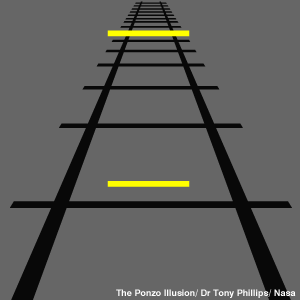
Ganel and his colleagues ‘hooked participants’ index finger and thumb to computerized position tracking equipment and asked them to grasp the objects with their fingers. Even thought the object appeared to be larger (or smaller) than it really was, the size of their grasp reflected the object’s real rather than apparent size. For good measure, the researchers arranged the illusion so that the object that appeared to be the smaller of the two was actually the larger of the two.’
Ganel argues that the experiment provides compelling support for the ‘two visual systems’ hypothesis put forward by Mel Goodale and David Milner about a decade ago (see Goodale and Milner 1992; Milner and Goodale 1995; for an overview, see Goodale and Humphrey 2001). According to Goodale and Milner, one visual system processes input for object and color recognition, recognizes objects no matter what the perspective of the viewer, and uses conscious parts of the brain; another visual system judges spaces, movement and object trajectories in egocentric space in order to control body movement, and does not necessarily access conscious thought. I’ve written about the two visual systems hypothesis elsewhere in a book chapter that just came out (Downey 2008), so Daniel probably recognized that I’m a bit of a fan of the ‘tectopulvinar’ (motion control) visual system. (For a quick overview of the two systems, this is a good set of diagrams and explanation.)
 Neuroanthropology