Steven Pinker and the Moral Instinct

By Daniel Lende 

Steven Pinker is selling something.  Here’s what’s on the table: “the human moral sense turns out to be an organ of considerable complexity.”  This organ has been built into our brains by evolution, culture-free except for how its five domains (harm, fairness, community, authority, and purity) are “ranked” and “channeled” in different places around the globe.  Ready to buy? 

Let’s sweeten the deal.  Pinker is offering his “deeper look” which will help you “rethink your answers” about life and morality.  He’s providing “a more objective reckoning” to help people get over their moral “illusions.”  And he’s got the data to show it, from people in the lab, Web sites, and brain scanners.  (I can’t help asking, these are his moral examples?  People in artificial situations, people who don’t physically interact, and a series of images?)  Continue reading “Steven Pinker and the Moral Instinct”
Autism and Mirror Neurons

Autism has been my latest lens for learning about neuroanthropology. It started with reading claims that autism is linked to mirror neuron disfunction. Mirror neurons are currently used to explain how the brain understands the intentions and emotions of others. Researchers suggest that lack of brain activity in mirroring areas of the brain found in autistic children could explain deficits in social interaction and empathy. A related article on the site links the mirror system to the study of culture: Culture Influences Brain Cells: Brain’s Mirror Neurons Swayed By Ethnicity And Culture. A study compared reactions of subjects to both American and Nicaraguan hand gestures, measuring differences in mirror neuron activity in the brain depending on who was giving the information and whether they were a member of their own ethnic group or a different group.

“We believe these are some of the first data to show neurobiological responses to culture-specific stimuli,” said Molnar-Szakacs. “Our data show that both ethnicity and culture interact to influence activity in the brain, specifically within the mirror neuron network involved in social communication and interaction… An important conclusion from these results is that culture has a measurable influence on our brain and, as a result, our behavior. ” “We are the heirs of communal but local traditions,” said Iacoboni. “Mirror neurons are the brain cells that help us in shaping our own culture. However, the neural mechanisms of mirroring that shape our assimilation of local traditions could also reveal other cultures, as long as such cross-cultural encounters are truly possible. All in all, our research suggests that with mirror neurons our brain mirrors people, not simply actions.”

I’m still trying to wrap my mind around this article—it seems as if it would be a given that culture impacts behavior so am not sure if they discovered something new so much as found a more scientific way of measuring it. Could this possibly be a tool that would indicate whether someone would suffer from culture shock? And linking it back to the first article, would this imply that autistic people would have equal trouble picking up on social cues regardless of who they are with while for others it would depend on whether they share the same cultural background?

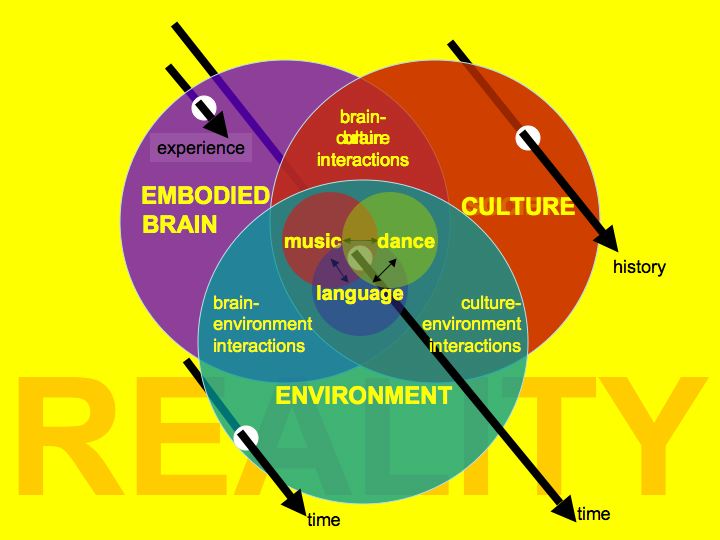
Paul Mason: Slides on Neuroanthropology

Paul Mason has sent me PowerPoint slides on Neuroanthropology that draw upon a lot of the same resources that he cited in an earlier post I put up on his behalf. Paul’s in the field in Indonesia, and he writes in sometimes from internet cafes, but we should eventually have him as a regular contributor when he’s back with some regular Internet access. And then he can also tell us more, too, about his own research.

Paul includes a number of choice quotes, but I wanted to make sure that everyone got a chance to see his diagram of a systems-based approach to ‘fight-dancing’ in cultural, biological, and ecological context (in both Indonesia and Brazil). It’s a rich diagram, and I think that we, as neuroanthropologist, will need to do a lot of complex visualization in order to make our points to a broad audience. Paul must get all the credit for this one.Mason slideIn the meantime, i don’t yet have a complete bibliography on this material, so we’ll have to get in touch with Paul if anyone really wants to get the sources he’s using. He sent this about a month ago, and I was not clear on how to post PowerPoint slides, but I think it’s pretty straightforward. We’ll see….neuroanthropology.ppt